Content Strategy Campaign
Campaign commercial
Turning IT challenges into
personalized solutions
RED HAT | KEEP YOUR OPTIONS OPEN
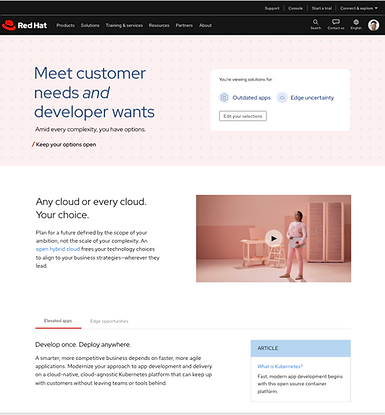
I assisted with a homepage hero and pill selector strategy for Red Hat's commercial brand campaign, using taxonomy and Adobe Target metadata to connect real-world tech pain points to personalized solution paths. I also contributed to the commercial ad print copy.
THE CHALLENGE
Enterprise IT teams face invisible constraints that most vendors ignore by leading with solutions before understanding the real problem. We needed a way to start with our audiences' real struggles while using language as the primary targeting signal.
THE APPROACH
Use audience research, taxonomy, and Adobe Target metadata to design a personalized experience that surfaces relevant solutions based on users' top challenges-before they know what they need.
THE IMPACT
-
More relevant journeys lead to higher engagement
-
Increased time on page and solution exploration
-
Improved path-to-solution conversion rates
-
Strengthened message relevance and brand trust
USER JOURNEY(SIMPLIFIED)
TOOLS USED
1. User lands on homepage hero and reads the
challenge message.
2. User selects top tech challenges (pill selector).
3. Adobe Target uses taxonomy + metadata to map selections.
4. User is taken to the Solutions Hub with relevant solutions.
5. User explores and engages with personalized content.
Adobe Analytics
Adobe Target
Contentful CMS


Creative portion

Users select their pain points and get tailored solutions on the Solutions Hub.

CONTENT MAP - GTM FRAMEWORK TAGS
Each row maps a business challenge to a product line, solution path, and topic tags.
This is the architecture Adobe Target used to serve personalized content.
FRAMEWORK I ESTABLISHED
The tone and taxonomy decisions were designed to be reusable. The pain point language framework established two distinct audience voices that could be applied across future personalization campaigns. The content map became the governance document for how Adobe Target routing decisions were made going forward.
STYLE GUIDE - VOICE + TONE DECISIONS
Developer / technical audience
Tone principle: validate first, solve second
WHY THIS WORDING
"Overloaded" is emotional and immediate—it says we see you before we pitch anything. Developers don't self-identify as a productivity problem. They identify as people being asked to do too much. The word validates that feeling before offering a solution.
NOT Developer productivity · Team capacity issues · Resource constraints
—themes that distances rather than connects.
Tone principle: speak the frustration, not the business metric behind it.
Overloaded devs
WHY THIS WORDING
Simple, universal, undeniable. Every developer has a mental list of things they do manually that they shouldn't have to. "Repetitive tasks" names the category without assuming what's on their list—which means it works for every developer, regardless of stack or role.
NOT Manual processes · Workflow inefficiency
—too abstract, sounds like a management memo not a developer's lived experience.
Tone principle: leave space for the user to see themselves in the language.
Repetitive tasks
WHY THIS WORDING
"Outdated" is a developer's word — it carries technical judgment. It implies something that should have been modernized already, which creates urgency without being alarmist. It also subtly signals that the reader is forward-thinking enough to recognize the problem.
NOT Legacy systems · Technical debt
—"legacy" is too polite, "technical debt" is too finance-brained for a developer audience.
Tone principle: use language that makes the reader feel like the smart one in the room.
Outdated apps
Business / IT leader audience
Tone principle: protect ego, name external obstacle
WHY THIS WORDING
"Incompatible vendors" puts the blame on the vendors, not the IT leader who chose them. That's intentional — it protects ego while naming the frustration. A leader is more likely to click something that validates their situation than something that implies they made a bad decision.
NOT Vendor management challenges · Poor technology choices
—one is too vague, the other implies fault.
Tone principle: the obstacle is always outside the reader, never inside their decisions.
Incompatible vendors
WHY THIS WORDING
"Disconnected" is a strategic word — it implies a fixable systems problem, not a people problem. For an IT leader responsible for infrastructure decisions, this framing makes the solution feel achievable. It also directly mirrors Red Hat's open hybrid cloud positioning without naming it.
NOT Multi-cloud complexity · Cloud sprawl
—"sprawl" implies lack of control, which stings; "complexity" is too generic.
Tone principle: language that names the problem should already gesture toward the solution.
Disconnected clouds
WHY THIS WORDING
"Uncertainty" is a business leader's word — it maps to risk, which maps to budget conversations, board questions, and strategic planning. "Edge" signals technical awareness without requiring technical depth. Together they say: this is a smart business problem, not just an IT problem.
NOT Edge computing challenges · Network latency issues
—too technical for an IT leader audience, loses the strategic framing.
Tone principle: technical terms earn their place only when they carry weight for the reader.
Edge uncertainty
These weren't just word choices, they were routing decisions. Each label was a targeting signal that told Adobe Target which content path to serve, which solution hub to surface, and which product narrative to prioritize.
Clarity
Simplistic headline cuts complexity.
Empathy
Pill copy speaks to user research pain points.
Personalization
Users shape their own solution path.
Taxonomy
Adobe Target and metadata ensures accurate solutions.
Design
Clean Ul helps users quickly identify and act on what matters.
Enpowerment
Users feel in control of their journey.
CONTENT STRATEGY PRINCIPLES APPLIED